Track, Understand, and Combat Land Degradation in Iraq
Evidence, tools, and training to help Iraq achieve LDN (SDG 15.3).
Aligned with UNCCD good practice, Iraq LD Monitor tracks the three LDN indicators—Land Cover, Land Productivity, and Soil Organic Carbon—through regularly updated datasets and transparent methods. Interactive maps, time-series trends, and downloadable charts/statistics and maps support policy design that protects ecosystems while improving rural livelihoods.
By translating complex geospatial data into clear insights, Iraq LD Monitor strengthens national capacity to achieve LDN (SDG 15.3), respond to degradation hotspots, and measure progress against national strategies for sustainable land management.
Methodology
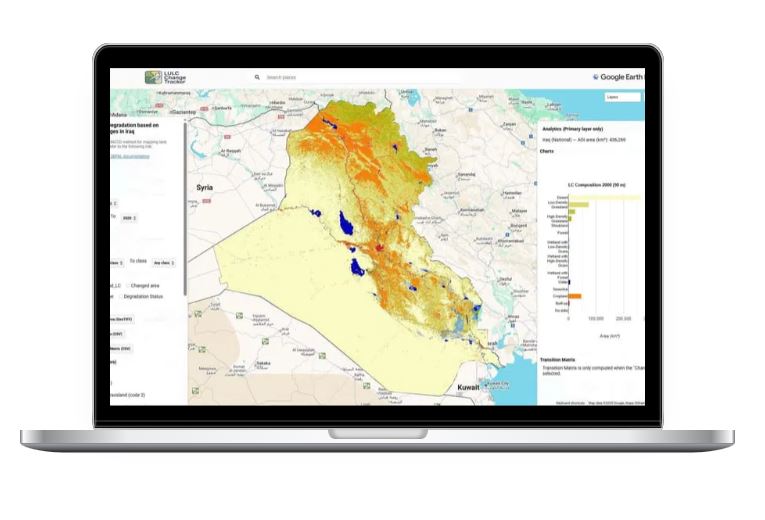
How do we monitor land degradation?
Land degradation refers to the gradual reduction or loss of land’s biological or economic productivity and complexity due to pressures such as land use and management practices. Under the framework of SDG 15.3 of the United Nations Convention to Combat Desertification, progress is measured using indicator 15.3.1, which calculates the proportion of degraded land over total land area. Because land degradation is multi-dimensional and cannot be captured by a single metric, the methodology relies on three complementary sub-indicators: land cover and land cover change, land productivity trends, and changes in carbon stocks, particularly soil organic carbon. These are combined using a precautionary “One-Out, All-Out” logic, whereby a land unit is classified as degraded if any one of the three indicators shows a negative trend. The approach enables consistent global monitoring and comparison over time, but it captures the presence rather than the severity of degradation and must be interpreted alongside national data, local context, and ground observations to effectively inform land restoration and sustainable land management policies.
Learn MoreDecision Support Tools
KPIs


Data & Products
National Land Cover, Change and Degradation Status in Iraq (2000–2020)
Using GLCLU v2 land-cover data and the UNCCD SDG 15.3.1 methodology, this product describes Iraq’s land-cover composition in 2000 and 2020, quantifies transitions between classes, and classifies areas as degraded, improved, or stable. The accompanying maps, charts and statistics offer an authoritative baseline for national reporting and decision-making on land resources.
Learn MoreAnbar
Anbar is Iraq’s largest governorate, with a total area of about 123,700 km². The governorate is dominated by arid and semi-arid environments, with cultivated land and permanent water bodies concentrated along the Euphrates River and around major reservoirs and oases. This profile summarizes land-cover conditions in 2000 and 2020, quantifies land-cover transitions over the 20-year period, and interprets land degradation status and types according to the UNCCD SDG 15.3.1 methodology. All statistics are derived from the GLCLU v2 (30 m) land-cover dataset, aggregated over the Anbar administrative boundary using the dedicated Iraq Land Degradation Mapping Tool.
Learn MoreThi Qar
This report summarizes land-cover conditions in ThiQar Governorate for 2000 and 2020, quantifies land-cover transitions over the 20-year period, and interprets land degradation status and types according to the UNCCD SDG 15.3.1 land-cover change framework. All statistics are derived from the GLCLU v2 (30 m) land-cover dataset aggregated to the ThiQar administrative boundary.
Learn MoreAl Muthanna
This report summarizes land-cover conditions in Al Muthanna Governorate for 2000 and 2020, quantifies land-cover transitions over the 20-year period, and interprets land degradation status and types according to the UNCCD SDG 15.3.1 land-cover change framework. Statistics are derived from the GLCLU v2 (30 m) land-cover dataset aggregated to the Al Muthanna administrative boundary.
Learn MoreLandCover for 2000
Raster map of land-cover classes in Iraq for the year 2000 derived from the GLCLU v2 dataset, showing spatial distribution of major land cover types (e.g., desert, grassland, cropland, wetlands, water, built-up). Includes a legend file detailing class codes and colors.
Learn MoreLandCover for 2005
Raster map of land-cover classes in Iraq for the year 2005, based on the GLCLU v2 dataset. Represents major land cover categories across the country and supports analysis of land-cover status at five-year intervals. Includes associated legend.
Learn MoreLandCover for 2010
Raster map showing the spatial distribution of land-cover classes in Iraq for 2010, produced from the GLCLU v2 dataset. Used to compare changes in land cover over time when paired with other year maps. (Legend included).
Learn MoreLandCover for 2015
Raster land-cover classification for 2015 across Iraq from GLCLU v2 data. Captures the extent of vegetation, bare land, water, built-up and other classes as a baseline for change analysis. (Legend file attached).
Learn MoreLandCover for 2020
Raster map of land cover in Iraq for the year 2020 derived from the GLCLU v2 dataset. Provides the most recent snapshot of national land-cover conditions and is used in degradation and change assessments. (Legend included).
Learn MoreLandcover change (2000_2005)
Raster dataset showing pixel-level transitions in land cover between 2000 and 2005. Each pixel value indicates a specific change class (e.g., desert → cropland), following the GLCLU v2 classification scheme. Legend file included.
Learn MoreLandcover change (2005_2010)
Raster depicting land-cover transitions from 2005 to 2010, highlighting areas that changed class over the period using standardized change codes. Legend provided.
Learn MoreLandcover change (2010_2015)
Raster layer of land-cover class changes between 2010 and 2015 (GLCLU v2 based). Useful for understanding temporal dynamics in land cover across Iraq. Legend included.
Learn MoreLandcover change (2015_2020)
Raster dataset showing changes in land-cover classes between 2015 and 2020, with values corresponding to specific class transitions. Includes legend.
Learn MoreLandcover change (2000_2020)
Long-term land-cover change raster showing aggregated transitions over the 2000–2020 period. Highlights major conversions across two decades, facilitating trend analysis. Legend included.
Learn MoreDegradation state (2000-2005)
Raster classifying land-degradation status over 2000–2005 according to UNCCD SDG 15.3.1 methodology. Pixel values indicate “No Change”, “Degraded”, “Improved”, or “No Data” based on land-cover transitions. Legend file attached.
Learn MoreDegradation state (2005-2010)
Raster layer of land-degradation status between 2005 and 2010, using UNCCD compliant rules applied to GLCLU v2 transitions. Pixel values map to degradation categories. Legend included.
Learn MoreDegradation state (2010-2015)
Map showing SDG 15.3.1 degradation status for 2010–2015. Each pixel indicates whether land remained stable, improved, degraded, or has no data. Legend file provided.
Learn MoreDegradation state (2015-2020)
Raster representing land-degradation status for 2015–2020, classifying spatial units into degradation categories under UNCCD guidelines. Legend included.
Learn MoreDegradation state (2000-2020)
Two-decade degradation status raster (2000–2020), classifying land into stable, degraded or improved states based on observed land-cover change patterns. Legend provided.
Learn MoreDegradation type (2000-2005)
Raster layer showing specific types of degradation and improvement processes between 2000 and 2005 (e.g., desertification, cropland expansion, vegetation gain, wetland loss). Values follow a detailed process legend. Legend file included.
Learn MoreDegradation type (2005-2010)
Raster depicting the dominant degradation and improvement processes over 2005–2010 using standardized process classes. Legend provided.
Learn MoreDegradation type (2010-2015)
Map of degradation and improvement process types for 2010–2015, identifying spatial patterns of ecosystem change (e.g., desert greening vs. vegetation loss). Legend included.
Learn MoreDegradation type (2015-2020)
Raster of detailed degradation/improvement categories for the 2015–2020 period, following UNCCD/GLCLU analytical framework. Legend attached.
Learn MoreDegradation type (2000-2020)
Comprehensive raster of degradation and improvement types across the full 2000–2020 interval. Values classify specific change processes (desertification, urbanization, wetland loss, ecological restoration, etc.). Legend included.
Learn MoreKnowledge Hub
SLM Best Practices & Guidelines
Events

FAO Iraq, through the GEF-funded project “Sustainable Land Management for Improved Livelihoods in Degraded Areas of Iraq,” is building national capacity to assess and monitor land degradation and support evidence-based SLM decision-making. This training will equip government and local authority staff with practical skills to collect accurate spatial field data and apply advanced remote sensing and GIS tools (e.g., Map Marker, ArcGIS Pro, Google Earth Engine) to feed a digital land degradation monitoring platform. The programme includes two days of field-based training in Basra, six days of technical training in Baghdad, and a two-day platform handover at the Ministry of Environment, delivered by FAO specialist Dr. Mohsen Ramadan.

Southern Iraq faces severe soil salinity that threatens agricultural productivity, crop choices, and farmer livelihoods, driven by poor irrigation practices, intensive cropping, and declining water quality—risks that are worsening under climate change. This follow-up training will equip 27 Ministry of Agriculture extension officers to serve as Farmer Field School (FFS) facilitators on soil salinity management for sustainable agriculture. Trained officers will cascade the knowledge to 2,635 farmers in Thi Qar and Al Muthanna under the FAO–GEF project, promoting practical measures to reclaim and manage salt-affected soils and improve sustainable land and water management.