Methodology
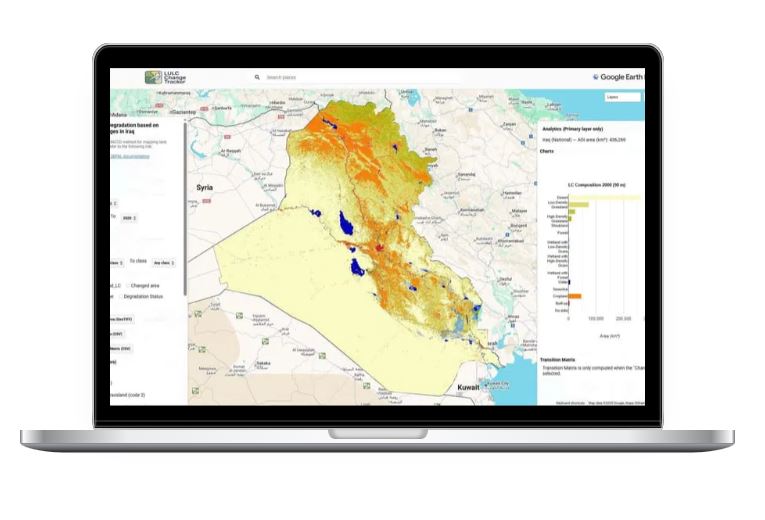
How do we monitor land degradation?
Land degradation refers to the gradual reduction or loss of land’s biological or economic productivity and complexity due to pressures such as land use and management practices. Under the framework of SDG 15.3 of the United Nations Convention to Combat Desertification, progress is measured using indicator 15.3.1, which calculates the proportion of degraded land over total land area. Because land degradation is multi-dimensional and cannot be captured by a single metric, the methodology relies on three complementary sub-indicators: land cover and land cover change, land productivity trends, and changes in carbon stocks, particularly soil organic carbon. These are combined using a precautionary “One-Out, All-Out” logic, whereby a land unit is classified as degraded if any one of the three indicators shows a negative trend. The approach enables consistent global monitoring and comparison over time, but it captures the presence rather than the severity of degradation and must be interpreted alongside national data, local context, and ground observations to effectively inform land restoration and sustainable land management policies.
Learn More