How can a farmer start practicing conservation agriculture?
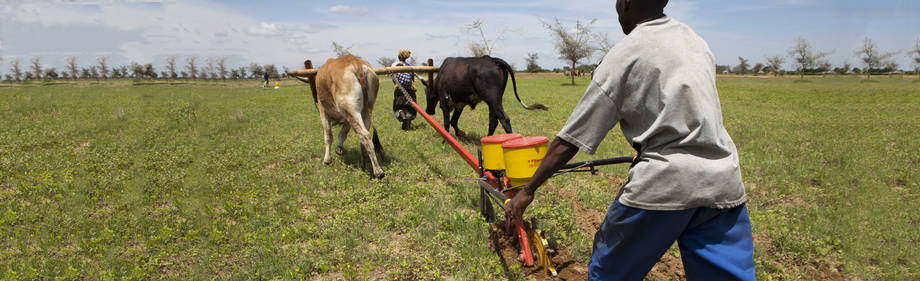
Start gradually and focus on realistic, achievable goals. To build experience, begin on a small portion of the farm. Choose an area with sufficient field cover (for ground cover) and use equipment designed for the task.If herbicides are used, take time to learn how to identify and apply them correctly, including understanding how to calibrate sprayers. Speak with other farmers who practice conservation agriculture and learn from their experiences and mistakes.Before starting conservation agriculture, one very important step is planning a sound crop rotation. Because conservation agriculture relies on soil life, soils must be brought to a condition where biological activity can develop. Prior to adoption, physical and chemical soil constraints should be addressed, such as compaction, drainage, and levels of P₂O₅, pH, and K₂O. This is especially important in severely degraded or exhausted soils, where rehabilitation may require targeted investments. Required measures may include:
- Subsoiling to relieve compaction
- Land leveling
- Liming
- Using green manure and mineral fertilizers to correct severe nutrient deficiencies
Soils under conservation agriculture generally improve over time. This means that the rate of degradation and erosion becomes lower than the rate of soil rebuilding. For this reason, even highly degraded soils should improve and become productive under conservation agriculture.In the first years, conservation agriculture efforts will focus on weed control; managing crop residues and cover crops; and monitoring the spread of pests and diseases. Farmers should be prepared for new habits and timelines. Conservation agriculture works by restoring natural processes and therefore requires a transition period before the system is fully established and natural balances are restored. New conservation agriculture farmers are advised to consult experienced practitioners to exchange knowledge and set realistic expectations.New adopters will also need an initial period to gain hands-on experience with innovation. Considerable information may be required on how to use and adapt equipment and field tools. The Brazilian concept of “farming clinics” is very helpful—not only for learning about tools and machinery, but also for understanding the time required to transition to the new system, crop performance during and after the transition period, and changes in labor and time requirements before and after adoption. The experience of farmers who have practiced conservation agriculture for longer periods can provide valuable guidance on the key practices for success and the mistakes to avoid. Establishing farmer field schools is another successful approach to collaborative learning that has proven effective in many countries.
Environmental conditions
Certain environmental conditions can accelerate successful promotion and adoption of conservation agriculture. In general, the following conditions often lead to suboptimal yields, farm income challenges, or environmental problems linked to farming activities:
- Hilly terrain
- Rainfall-driven erosion
- Dry climates with periods of extreme heat and drought
- Degraded and eroded soils
- High production costs
- Declining labor availability
- Reduced agricultural subsidies
Under these circumstances, shifting to conservation agriculture can generate rapid momentum because the results are often clear—especially to farmers. Where conservation agriculture organizations, farmer organizations, and experienced farmers exist, adoption can also lead to rapid improvements in the social and economic conditions of communities. Innovative farmers seeking alternative production systems to save money and improve productivity and soil health are often the first to adopt conservation agriculture—and they tend to be the ones who promote it within their communities.Source:
https://www.fao.org/conservation-agriculture/impact/ca-adoption/ar/