Sustainable Land Management (SLM)
The original copy of this article is available at:
https://www.fao.org/land-water/land/sustainable-land-management/ar/
The United Nations defines sustainable land management (SLM) as “the use of land resources, including soils, water, animals and plants, for the production of goods to meet changing human needs, while simultaneously ensuring the long-term productive potential of these resources and the maintenance of their environmental functions”. TerrAfrica (2005) defines SLM as “the adoption of land-use systems that, through appropriate management practices, enable land users to maximize the economic and social benefits from the land while maintaining or enhancing the ecological support functions of the land resources”. The productivity and sustainability of a land-use system is determined by the interaction between land resources, climate, and human activities. Especially in the face of climate change and variability, selecting the right land uses for given biophysical and socio-economic conditions, and implementing SLM, are essential for minimizing land degradation, rehabilitating degraded land, ensuring the sustainable use of land resources (i.e. soils, water and biodiversity) and maximizing resilience.Sustainable land use and management (human activities) decide the sustainability/resilience or degradation/vulnerability of land resources.
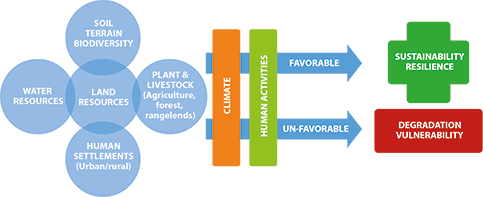
Source: FAO, CLIMATE-SMART AGRICULTURE Sourcebook, Module B.7 Sustainable Soil/Land Management for Climate-Smart Agriculture
SLM encompasses established approaches such as soil and water conservation, natural resource management and integrated landscape management (ILM). It involves a holistic approach to achieving productive and healthy ecosystems by integrating social, economic, physical and biological needs and values, and it contributes to sustainable and rural development. SLM is based on four principles:
- targeted policy and institutional support, including the development of incentive mechanisms for SLM adoption and income generation at the local level;
- land-user-driven and participatory approaches;
- the integrated use of natural resources on farms and at the ecosystem scale; and
- multilevel, multistakeholder involvement and partnerships at all levels – land users, technical experts and policy-makers.
FAO’s SLM mandate and comparative advantage
FAO has a mandate to support its member countries and partners in developing or reforming norms, standards, and policies; provide technical advice; and implement national and local programs through capacity development and technical knowledge management activities. FAO implements a range of SLM-related programs and approaches, such as farmer field schools; conservation agriculture; catchment- and farm-scale approaches to integrated land and water management and land husbandry; gestion des terroirs and local land-use planning; integrated plant and pest management; and sustainable forest management. FAO is the custodian UN agency for 21 indicators of the Sustainable Development Goals (SDGs), cutting across SDGs 2, 5, 6, 12, 14 and 15, and it is a contributing agency to four other SDG indicators. FAO has a strong comparative advantage in its capacity to assist countries in meeting the monitoring challenge posed by the SDGs.
Activities are under way for country-level collaboration in the development of indicators for land; land degradation; soils; drought; sustainable forests and mountains; sustainable land management; water efficiency and scarcity; women’s access to land ownership; food losses and waste; and others. FAO is executing a number of projects, funded by the Global Environment Facility (GEF), addressing transboundary land degradation issues, including “Integrated Management of the Fouta Djallon Highlands”; “Globally Important Agricultural Heritage Systems”; “Transboundary Agro-ecosystem Management Programme for the Kagera Basin”; “Using Farmer Field School Approaches to Overcome Land Degradation in Agropastoral Areas of Eastern Kenya”; and “Integrated Natural Resources Management in Drought-prone and Salt-affected Agricultural Production Landscapes in Central Asia and Turkey” (CACILM2) (in development). FAO also implements integrated land resource planning strategies through a wide range of complementary SLM approaches, tools and measures adapted to different biophysical and socio-economic contexts. Land degradation and desertification threaten the food security and livelihoods of millions of people, especially in drylands. Promisingly, after many decades of on-the-ground work on SLM approaches and practices, many SLM options are available for reversing these negative trends. FAO is prioritizing the identification of affected communities and target areas for implementing locally suitable SLM options for managing land resources with the overall goal of scaling up SLM over large areas. FAO-developed similarity analyses are used to match areas of interest with areas where farmers have tested, fine-tuned and implemented SLM technologies and where water and land management packages might be applied. Professionals, planners and decision-makers can use the information and products generated from these analyses to identify the most suitable SLM practices and technologies for targeted areas and communities. ILM and land resource planning are other tools for supporting decision-makers and land users in choosing suitable land uses and SLM practices for local biophysical and socio-economic circumstances.